Faster development starts with better intelligence: Inside Paces Automated Reports

The new model of development demands faster de-risking
To say this has been a transformative year for Paces would be an understatement. From the beginning, our philosophy has centered on one goal: to accelerate the buildout of more clean energy projects for both load and generation developers.
The traditional model of energy development is sequential, time-consuming, and consultant-dependent, and it can't keep pace with today's demands. We're moving toward a new model of development where steps that once happened sequentially can now run in parallel and be dramatically compressed through automation and expert analysis. With the advances in AI, we believe almost all time-consuming manual tasks can be automated, enabling teams to build faster with fewer resources and ultimately getting more projects through faster. Every update to the Paces platform and service menu reflects this vision.
Why we built Paces Reports
Energy development still depends on leveraging de-risking insights at every step of the process. Understanding environmental, permitting, and community constraints is essential to buildout. Picking the best sites for development requires understanding environmental, permitting, and community constraints is essential to buildout. In development, it actually serves you to fail fast or understand the risks that could derail your projects and the likelihood of successfully connecting to power.
Historically, accessing this information has been painfully time-consuming. Many companies outsource analysis, relying on consultant reports that can take months to deliver or work in siloed teams with different groups handling only one facet of the risk equation before moving to the next phase. With data center demand surging in the background, we can't afford to wait that long for validation of energy infrastructure buildout.
This is why we've spent much of 2025 building out the automation and expertise behind Paces Reports. We've built industry-standard reports, including Power Flow Studies, CIAs, and Risk Reports, that are delivered faster through automation. With reports, developers can move away from the assembly line, sequential approach to de-risking and evaluate all risks concurrently by combining reports. And we're quickly moving toward a future where you can choose the exact data you need, when you need it, with modular reporting that help chart your course through project risk.
Our reports are built on a foundation of hundreds of geospatial, relational, and textual datasets that feed the Paces platform, integrating public, private, and proprietary data sources that refresh regularly to ensure you're always working with the most current information. We've taken this data infrastructure and layered automation and expert analysis on top to deliver reports in days, not months, that give you the insight you need to move sites closer to shovel-ready.
Paces Reports: from desktop analysis to grid connection
Each report in our offering is tied to an essential early step in de-risking. Our team of AI engineers, former developers, and power engineers have built a scope that encompasses the full due diligence process from permitting to power.
Power Flow Study: Understand grid impacts before you commit
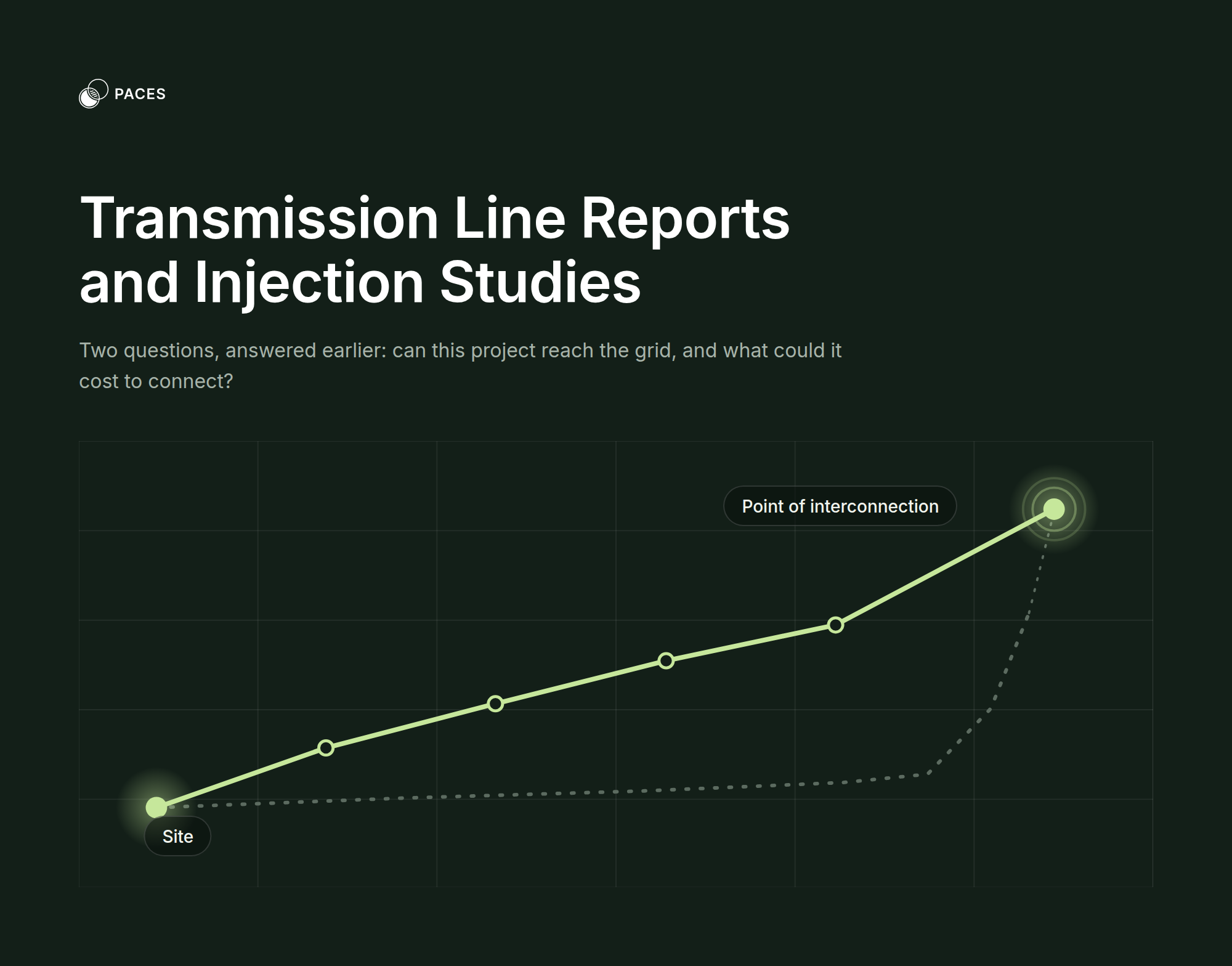
What it is: A detailed simulation to evaluate the impact of your proposed project on the grid, providing a clear path to interconnection feasibility. We've combined automated grid insights with expert power engineering to deliver a report that mirrors ISO and utility results in days, not months.
Why we built it: The make-or-break moment for any energy project is whether it can connect to the grid and at what cost. With Paces Power Flow Studies, you can confidently enter the interconnection queue because you understand all the risks upfront — including potential upgrade costs, constraint locations, and deliverability issues — before submitting your interconnection application.
Key Features:
- Multiple base cases for multiple potential commercial operation dates (CODs)
- Thermal and voltage N-0/N-1 analysis with industry-standard constraint criteria
- Mitigation solutions consistent with utility procedures
- Sensitivity analysis including conceptual upgrades that may positively or negatively impact the interconnection
Risk Report: Early visibility into development challenges
What it is: A high-impact desktop analysis built to identify early development risks across all critical dimensions: environmental, permitting, community sentiment, and power deliverability.
Why we built it: Developers evaluating sites need early visibility into potential challenges so they can make informed, data-driven decisions before spending months on diligence. By consolidating environmental constraints, zoning compatibility, community factors, and grid capacity into a single, readable report, we eliminate the need to gather and synthesize information from dozens of disparate sources manually.
Key Features:
- Environmental red/yellow flags highlighting potential constraints
- Permitting feasibility and zoning constraints including:
- Lightweight federal and state permits
- County and local permitting flags to be aware of
- Community sentiment and local incentives to inform engagement strategy
- Power deliverability risks(for Data Center Development) via steady-state capacity study across multiple cases (normal & N-1 contingency conditions)
Critical Issues Analysis: Civil-level depth without the site visit
What it is: A civil-style environmental and permitting review delivered fast and affordably. We assess environmental, permitting, and land use constraints across federal, state, and local layers, including wetlands, protected habitats, flood zones, zoning compatibility, and permitting feasibility. The CIA flags risks that could derail your project.
Why we built it: Developers still require consultant-level depth on risks that could derail projects, but traditional reports either require expensive site visits or months of tedious research. Through our automated research workflow and proprietary data access, we deliver comprehensive civil-style assessments with one click.
Key Features:
- De-risk acquisition and diligence with upfront fatal flaw identification
- Uncover critical constraints early, including wetlands, protected habitats, flood zones, zoning compatibility, and permitting feasibility
- Support investor confidence with narrative analysis that provides clear go/no-go guidance
Automation meets expertise: How we deliver speed without sacrificing accuracy
What makes Paces Reports different is speed, powered by automation and human validation working together.
Our automation handles data aggregation, spatial analysis, and initial risk flagging across millions of data points. Then, our team of experts, former developers and engineers who've worked on both sides of the development process, reviews, validates, and contextualizes those findings.
This hybrid approach means you get:
- Speed: Automated data processing delivers results in days instead of months
- Accuracy: Expert review ensures findings are actionable and relevant to your specific project context
- Confidence: Every report is backed by both proprietary data and domain expertise
The result: Parallel development at scale
Our goal with building out our reports is to accelerate development timelines while reducing risk exposure. As we continue to iterate, we're committed to driving turnaround times even lower without sacrificing the quality and depth our customers depend on.
This work has also been an exercise in cross-functional collaboration between our different product pods: AI engineers working alongside expert developers and power engineers to build tools that genuinely change how energy projects get de-risked and advanced.
Looking ahead, we're building toward a future to cover even more risk factors and where reporting becomes truly modular. Soon, you’ll have the flexibility to pull exactly the data and analysis you need for any stage of development, configured to your specific workflow. The foundation is already there: hundreds of datasets, continuously refreshed, combined with automation and expert validation. Now we're making it even more adaptable to how you actually work.
Whether you're a data center developer evaluating hundreds of potential sites or a renewable energy developer navigating complex interconnection challenges, Paces Reports give you the insights you need to move faster with confidence.
Get Started with Paces Reports
If you're interested in learning more about how Paces Reports can accelerate your development timeline and reduce project risk, reach out to our team at sales@paces.com or schedule a demo to see our platform in action.
From desktop analysis to grid connection, Paces is built to help you move from site to power, faster.
Sign up for emails
Find the right sites faster, assess feasibility with world class data, and track progress across your entire project pipeline with software built to compress your workflow.
.png)