
Case Studies
Insights into the future of clean energy and beyond.
June 2, 2026
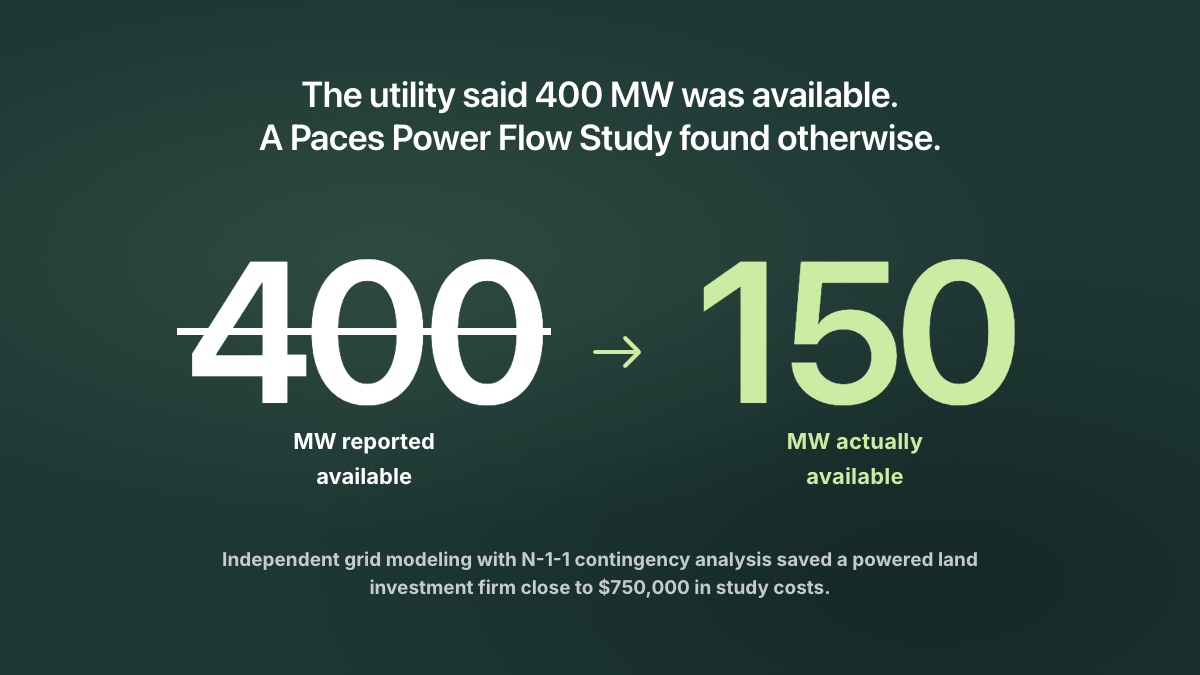
How a Power Flow Study saved a powered land investor from a multimillion-dollar mistake
A powered land investment firm was preparing to commit over $750,000 in interconnection study costs for an Ohio site after the utility confirmed 400 MW of available capacity. A Paces Power Flow Study revealed the real number was closer to 150 MW, fundamentally changing the project's viability and saving the team from a costly misstep.
Read more

April 21, 2026
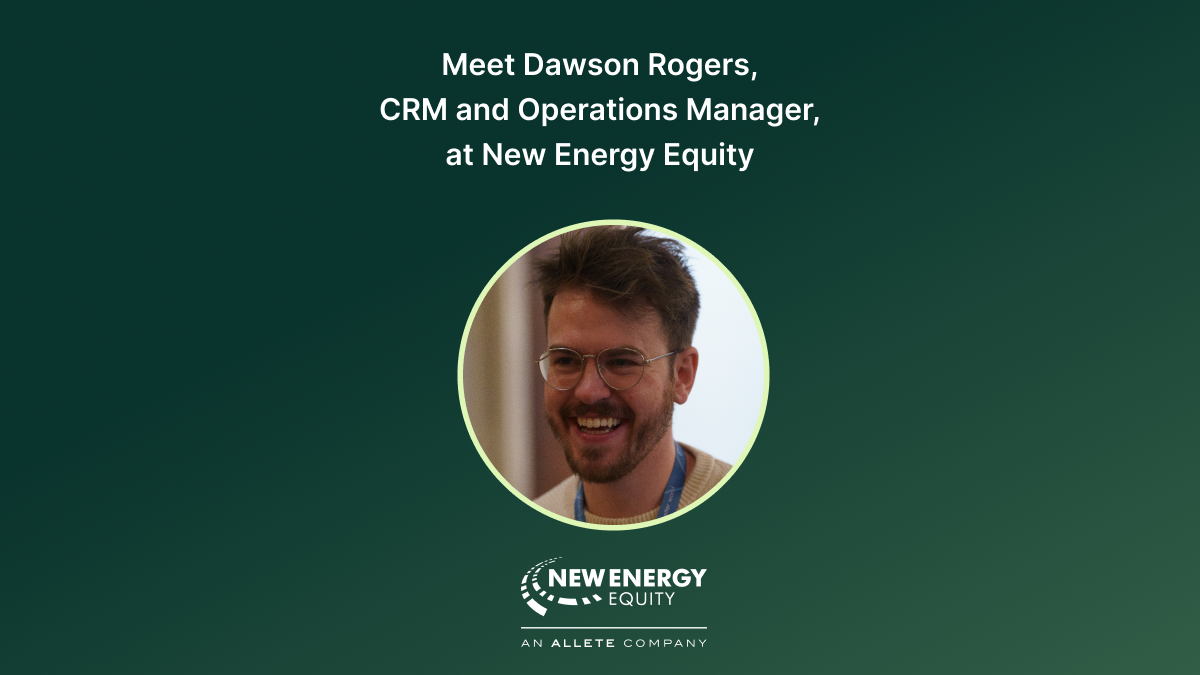
How New Energy Equity scaled solar origination across 16 states and saved $175,000 with Paces
New Energy Equity, a leading community solar developer with projects in 16 states and 600+ MW developed, needed to move beyond a fragmented, agent-by-agent origination process. With Paces, they built a standardized, team-wide site selection workflow that eliminated per-parcel cost constraints, cut the time from site identification to landowner outreach in half, enabled outreach to 60,000+ sites since using Paces, and achieved a 7.6% YoY increase in qualified sites contacted.
Read more
April 20, 2026
How EDF power solutions identified its strongest data center co-location sites across 90+ assets with Paces
As an independent power producer developing several GW of wind, solar, and BESS projects facing significant grid-interconnection delays, EDF power solutions needed a fast, rigorous way to determine which sites in their growing development pipeline were genuinely viable for data center co-location. With Paces, they triaged 90+ sites in weeks, built a tier-ranked pipeline, developed a lens on how AI data center developers viewed greenfield opportunities and began partnership conversations.
Read more

December 29, 2025
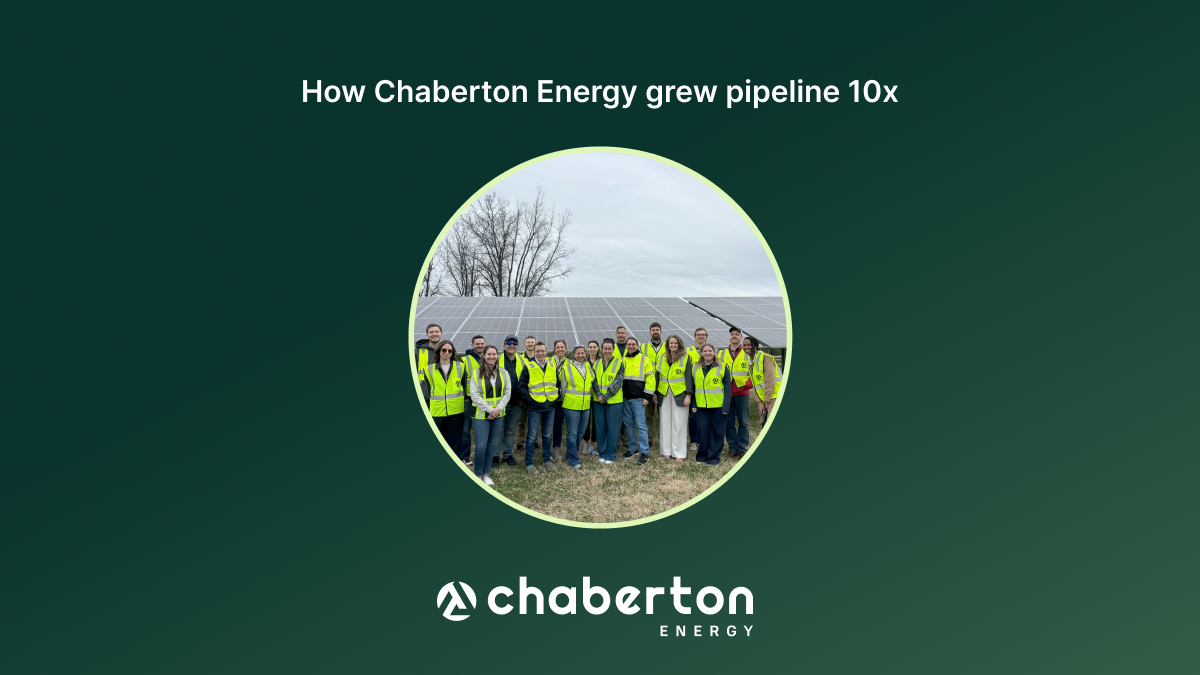
How Chaberton Energy grew pipeline 10x
As a distributed energy developer focused on community solar and storage, Chaberton Energy faced scattered data and tools built for the wrong scale. With Paces, they centralized their workflows, increased lead generation and close rate, and gained the agility to navigate changing market conditions, variable state and local regulations, and new markets.
Read more
December 17, 2025
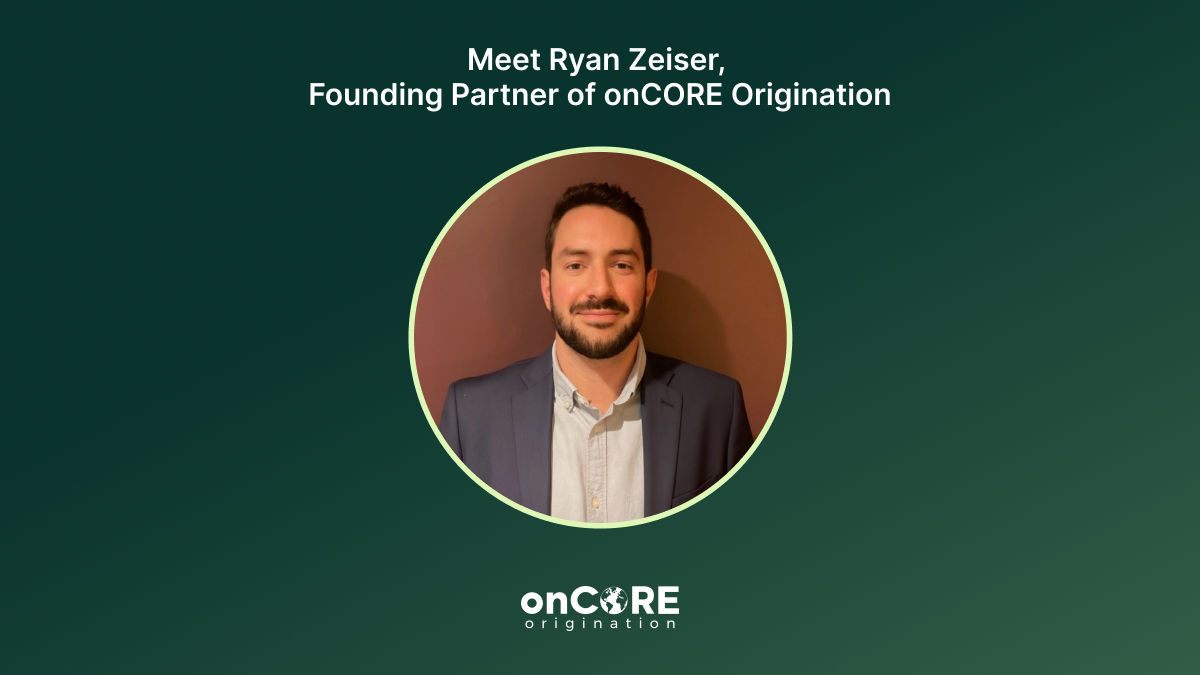
How onCORE Origination achieves 10x faster lead generation and 3 GW of projects with Paces
onCORE Origination built a renewable energy origination powerhouse, delivering over 3 GW and 300 projects across 20 markets with just 10 people. By leveraging Paces' centralized data and streamlined workflows, they transformed lead generation from an 8-hour manual process to 80 minutes, achieving 10x speed while scaling their assembly-line approach to consistently supply high-quality, pre-vetted sites to clients.
Read more
November 24, 2025
How Demeter Land Development de-risks origination and triples success with Paces
When Scott Aaronson founded Demeter Land Development, he set out to help developers secure the most strategic, de-risked land positions. But as Demeter expanded into new states and markets, the team faced the high stakes of early-stage origination—where even small mistakes could multiply into costly setbacks. To scale confidently and avoid wasted time on non-viable sites, Demeter needed reliable, high-quality data—and that’s where Paces came in.
Read more

November 24, 2025
How a lean solar development team scales and achieves big results with Paces
When Corey founded Radiant Power in early 2024, he was excited to bring his vision of community-focused solar development to life. But working with a lean team of two, he quickly realized the challenges of navigating the overwhelming world of site prospecting. Without the resources of a large team, Radiant Power needed a way to work smarter, not harder—and that’s where Paces came in.
Read more

More Resources
Recent Blogs
.png)
September 3, 2026
Interconnection Pathways: What Developers Need to Know Before Filing
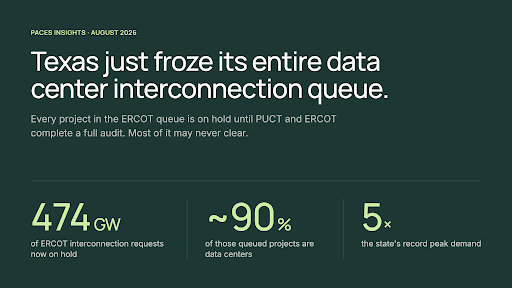
The first Paces Accelerate webinar explored how development teams can better understand interconnection requirements, timelines, costs, and project-specific exposure before committing capital.
Read more
Recent Reports

April 28, 2026
Data Center Site Analysis: March 2026
Our third monthly analysis expands to ten states and 35,517 tracked sites across Illinois, Indiana, Iowa, Missouri, North Carolina, Ohio, Oklahoma, Pennsylvania, Texas, and Virginia. Of those, 5,531 meet the premium threshold, but inventory is already shrinking. Read the report to find out how each market stacks up.
Read more
March 11, 2026
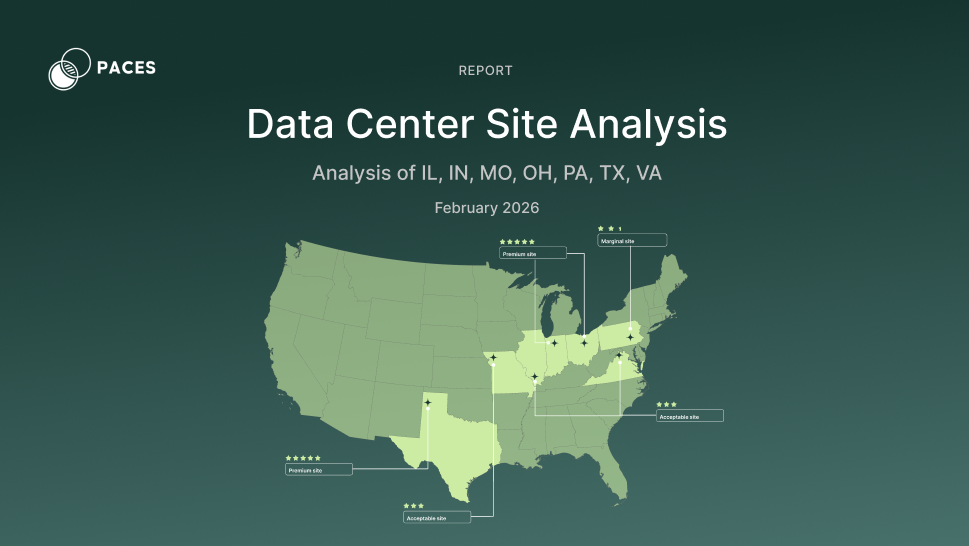
Data Center Site Analysis: February 2026
Our second monthly analysis expands to seven states and 23,792 tracked sites across Illinois, Indiana, Missouri, Ohio, Pennsylvania, Texas, and Virginia. Of those, 4,164 meet the premium threshold, but inventory is already shrinking. Read the report to find out how each market stacks up.
Read more
February 4, 2026
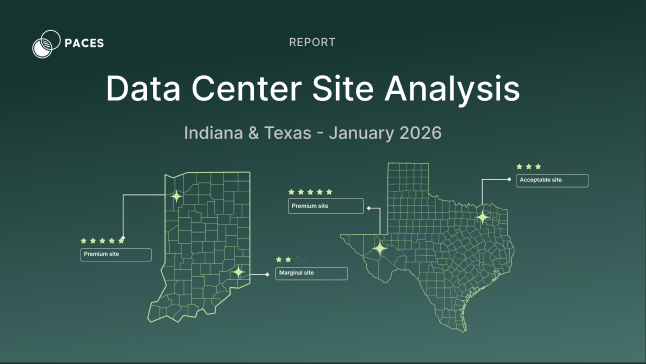
Data Center Site Analysis: Indiana & Texas - January 2026
The race for power-ready data center sites is intensifying. Our first monthly analysis covers 4,195 sites across Indiana and Texas, revealing which counties still have premium inventory—and how fast it's disappearing. Texas has lost viable sites every month since July 2025, with projections showing the trend will continue through mid-2026.
Read more

November 20, 2025
Hansford County, Texas Power Flow Study: How ERCOT can enable 1,345 MW of new load by 2030
Paces analyzed ERCOT grid capacity in Hansford County, Texas, revealing significant opportunities for large-scale data center development. Using 2028 and 2030 planning base cases, the study shows the region can support 853 MW of load by 2028 with zero system upgrades and scale to 1,345 MW by 2030 with only minor voltage enhancements. This analysis provides data center developers and energy infrastructure teams with a clear roadmap for securing gigawatt-scale grid capacity near Project Matador. Learn how staged interconnection and strategic POI selection can accelerate time-to-power for hyperscale facilities in Texas.
Read more
April 29, 2025
Renewable Energy Trends, Edition 3: Site Selection for Solar
Explore the latest trends in solar energy siting, including shifts in site availability, parcel size, and hosting capacity. This report highlights early signs of stabilization in key states and a rebound in hosting capacity after over a year of declines, with state-level data revealing new opportunities and predictive insights for the year ahead. Developers can learn strategies to navigate shrinking parcels, track feeder upgrades, and adapt to an increasingly competitive market. Stay ahead in the clean energy transition with real-time, data-driven intelligence.
Read more
December 9, 2024
Renewable Energy Trends, Edition 2: Site Selection for Solar
Explore the latest trends in solar energy siting, analyzing challenges like shrinking site availability, reduced parcel sizes, and declining feeder capacities. This report highlights a nationwide 21.9% drop in suitable sites and state-level data revealing key opportunities, as well as predictive data for next year. Developers can learn strategies to overcome obstacles, pinpoint optimal sites, and adapt to a competitive market. Stay ahead in the clean energy transition with data-driven insights.
Read more

October 16, 2024
Renewable Energy Trends, Edition 1: Site Selection for Solar
This report uncovers a growing challenge in renewable energy development: the rapid decline of suitable land parcels and other key site requirements for solar and wind projects in key U.S. markets like Illinois and New York. The report also highlights actionable strategies, including data-driven tools and early risk assessments, to help developers navigate these challenges and maintain momentum in the renewable energy transition.
Read more
