Half of Texas's 474 GW Data Center Queue Won't Survive This Audit. Will Yours?
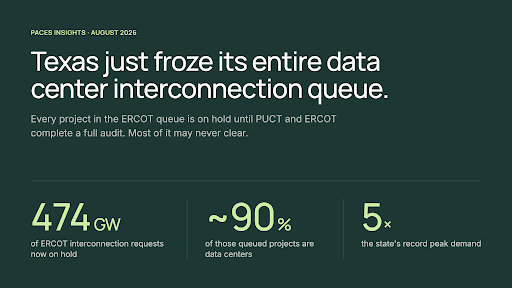
On August 3, Governor Abbott directed the Public Utility Commission of Texas and ERCOT to halt every data center project in the interconnection queue until a full audit is complete. This is functionally a moratorium and at Paces we are counting it as that until there is greater clarity.
This order affects 474 GW of ERCOT interconnection requests or more than five times the state's record peak demand. ~90% of it is data centers, and Paces customers have a meaningful share of it in their pipelines
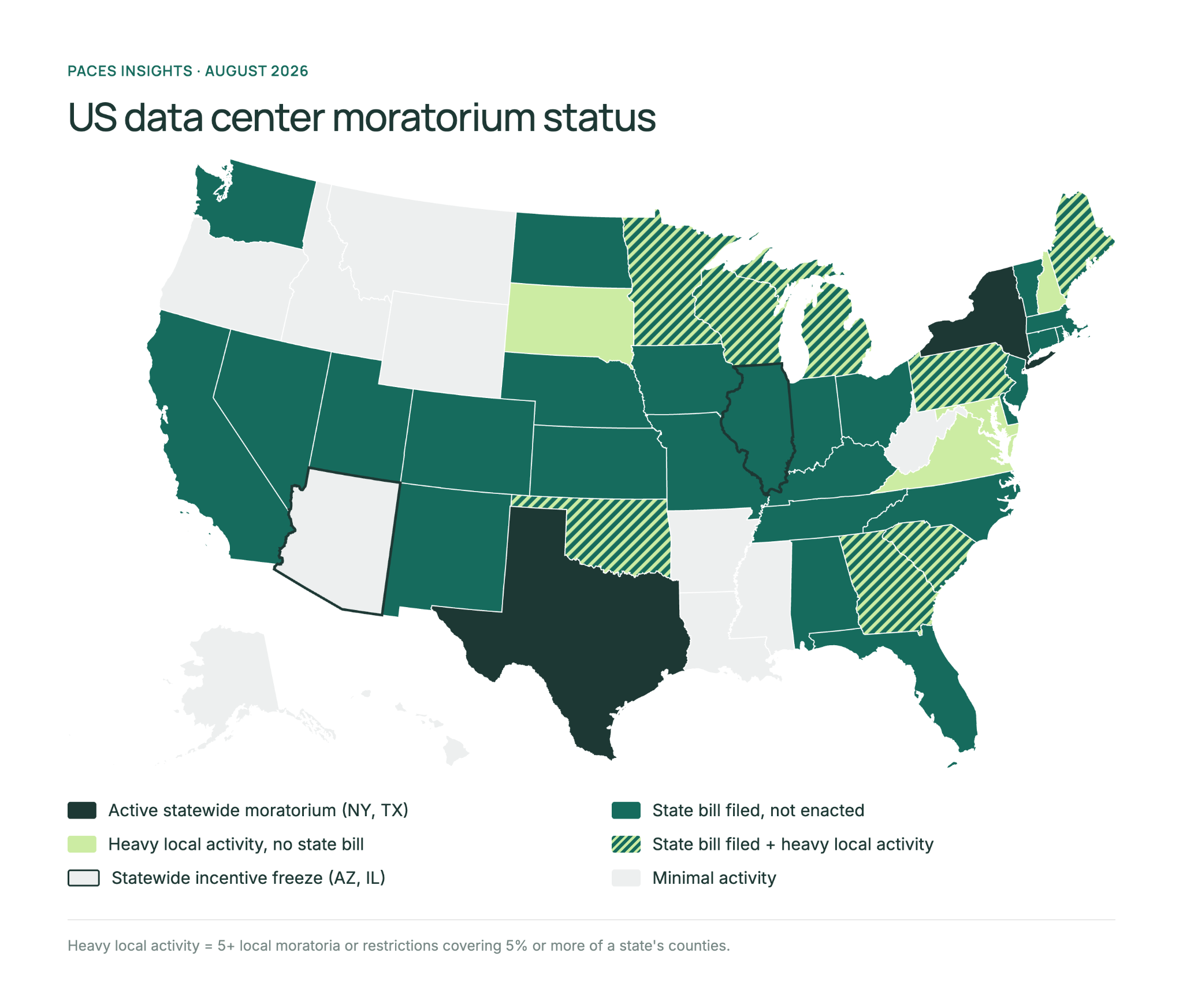
The direct damage to specific Texas project timelines is bad, but there are even larger concerns coming. You now have functional freezes in a very blue state (NY) and a very red state (TX); two of the two biggest development markets in the country. That is a permission structure for many of the state level legislatures to move existing data center moratoria bills forward. My honest expectation is that twelve months from now you see more than ten states that are currently highly active data center markets with some form of moratorium. Texas was the state that was never supposed to be on that list.
Texas's read is not entirely wrong; you can't run a grid on unverified, speculative load. It is very unfortunate how sudden this is, but every project now has to prove it's real to keep its place in line.
I wrote in February that clearing the power bar went from the most important part of data center development to table stakes. We are now seeing that the emergent constraint on development is community impact. We've been tracking this nationwide. The pattern is consistent: local sentiment has become the number one site-screening criteria for our customers, ahead of power availability, for the first time.
What the audit requires
PUCT and ERCOT now have to collect this on every project in queue:
→ Projected power consumption and any on-site generation plans
→ Projected water consumption and cooling technology
→ Noise and setback mitigation
→ Every tax incentive and abatement, received or expected
→ Who actually owns the project
It is likely that most of that 474 GW never makes it through the audit. Not because the projects are bad. Because they were never real; they were filed to hold a queue position, not to build. The developers with financing, site control, and real water and community answers already in hand will clear this in weeks. Everyone else is about to find out how speculative their pipeline actually was.
This is why we built what we built at Paces
Our approach at Paces is that power, permitting and other risks need to run in parallel, not sequentially. Texas has made the approach more necessary than ever.
We’ve spent the past several months building directly into this gap.
- Water Access maps the providers serving a site: their supply, capacity, and constraints. You know whether the water a project needs actually exists before you commit capital.
- Water Outreach goes further. It engages the utilities and districts directly to confirm capacity and willingness to serve. Real documented evidence, not a guess about the aquifer.
- Sensitive Receptors, one of the newest modules on the platform, flags every school, hospital, and church within a kilometer of a site. You know your exposure before the first public meeting.
- Regulatory Pathways and Permitting Matrix maps every permit a project needs, jurisdiction by jurisdiction. The paperwork trail exists before a regulator asks for it.
None of this is a Texas-specific fix. It's the same diligence New York, Arizona, and Illinois are already asking for, just in different forms. More states will follow before the year is out.
If you've got sites in the ERCOT queue right now, we can run these modules against your pipeline today. Reach out to the team.
If you agree or disagree with any of this, reach out to me on LinkedIn.
Sign up for emails
Find the right sites faster, assess feasibility with world class data, and track progress across your entire project pipeline with software built to compress your workflow.
.png)