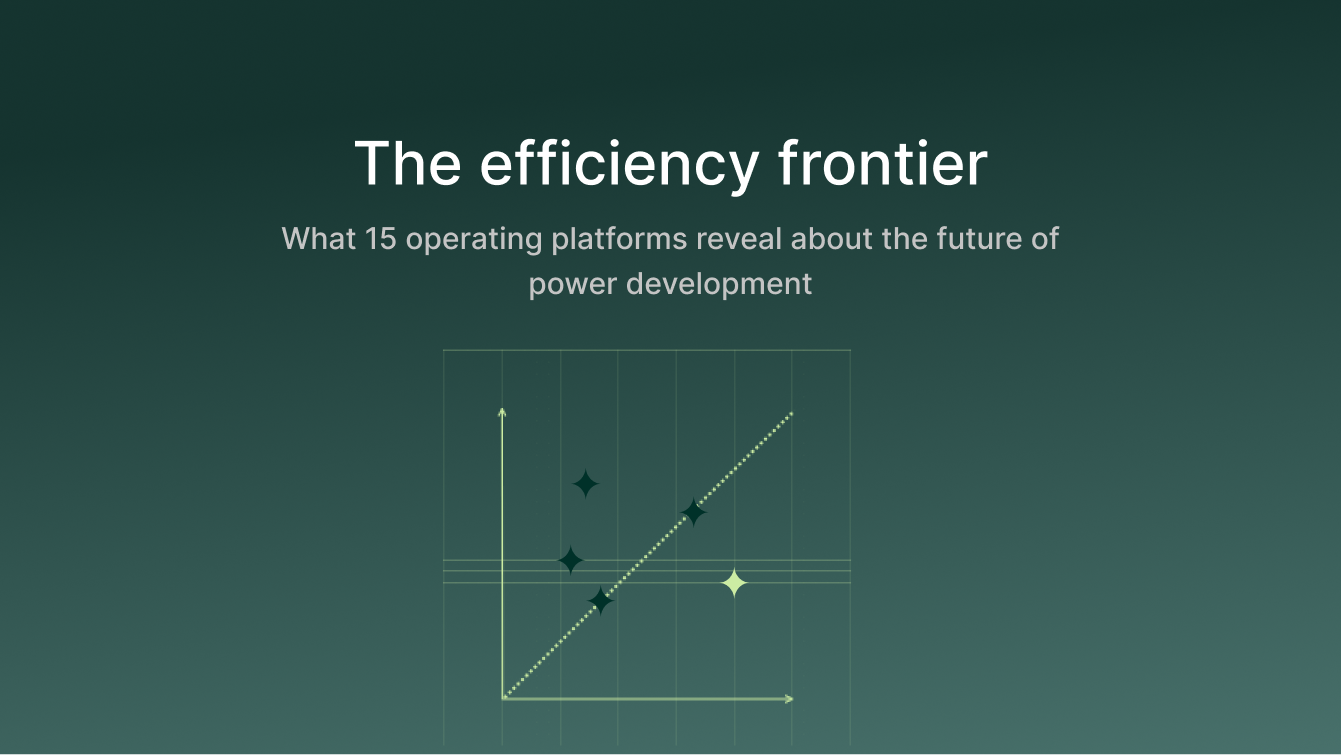
The efficiency frontier: what 15 operating platforms reveal about the future of power development
For a decade, institutional capital coalesced around a single milestone in renewable power: one gigawatt of operating assets. Hit that mark, and you proved your management team. You proved your platform. You proved you were investable.
The companies that reached it cleanly tell a remarkably consistent story:
- Altus Power runs 1 GW with 113 full-time employees.
- Luminace manages 1.5 GW with roughly 100.
Plot them on a chart and they sit right on what became the industry's implicit benchmark: approximately 100 people per GW. These are genuinely good businesses. And for years, they defined what "good" looked like.
But the last 18 months forced something unusual. Between IPOs, restructurings, and fundraises, the industry surfaced data it rarely shares: actual operating portfolios, actual headcount, actual capital structures. For the first time, you can look across 15 platforms and ask a question that turns out to be far more interesting than expected: what does it actually cost in people and capital to own and operate a gigawatt of clean power?
The benchmark was never the whole picture
Zoom out to the full dataset and the 100 FTE/GW line was never the whole picture. Three distinct clusters emerge around it.
- Lean utility-scale operators like TerraForm NA and Terra-Gen run at 55 to 68 FTE per GW. These are extremely asset-light platforms built for pure ownership and operation, not development.
- Distributed and commercial solar platforms like Nexamp, DSD, and Solar Landscape cluster at 400 to 1,000+ FTE per GW. That sounds wildly inefficient until you understand the business: hundreds of small sites, direct customer relationships, ongoing management of behind-the-meter assets. The headcount is structural, not a sign of bloat.
- Developer-operators carry the overhead of an active development engine against a maturing operating portfolio, and they tend to cluster in the 125 to 200 FTE/GW range. The development headcount is building future gigawatts, but it inflates the ratio when measured against today's operating portfolio alone.
The takeaway is simple: the right benchmark depends entirely on what kind of company you're building.
A new model is emerging at the edge
Here's where it gets interesting. Two platforms in particular stand out.
- A climate infrastructure manager is targeting roughly 500 MW with about 500 million dollars in capital and a lean 10-person team which is around one-tenth the typical headcount at that scale
- Another renewables platform is pursuing a similar model at roughly half that scale (about 250 MW, 250 million dollars of capital, and a 5–7 person team).
These aren't anomalies. They represent a structural shift enabled by better tooling at every stage of the development workflow. When we wrote about the "one-person, billion-dollar power development company" last year, the idea that a single person could reliably move 500 MW/year of pipeline felt ambitious. These teams are already proving that the math works at dramatically reduced headcount, and they're doing it now.
What makes this possible
The efficiency frontier is moving because the work itself is changing. Siting, permitting, interconnection, environmental review, financial modeling: tasks that once required dedicated functional teams can now be compressed through automation and parallel execution. Our CEO, James, wrote about this paradigm shift in his thesis, "The One-person, one billion dollar power development company" back in September, but with the evolving rate of agentic workflows, this reality is closer than ever.
Desktop diligence that took weeks runs in minutes. Interconnection applications that required months of back-and-forth get assembled with high-fidelity data from day one. Environmental screening that used to gate the entire process now runs concurrently with everything else. The sequential, high-headcount model isn't broken. It's just no longer the only option.
Agentic platforms are compressing the development workflow in ways that would have seemed implausible even two years ago. The developers who internalize that shift earliest will have a durable advantage, not because they'll build worse projects, but because they'll build more of them, faster, with fewer resources at risk.
The 1 GW milestone still matters
None of this invalidates the platforms that built to the old benchmark. A well-run 100-person company managing a gigawatt of renewable power is still a great business. But the path to getting there is changing. The frontier is moving. And the developers writing new rules are the ones worth watching.
Whether you're building at the scale of the traditional model or compounding from the edge, the question is the same: how fast can you get de-risked projects to power?
We'd like to help you answer it. Build with Paces.
Sign up for emails
Find the right sites faster, assess feasibility with world class data, and track progress across your entire project pipeline with software built to compress your workflow.
.png)