The future of due diligence: AI-accelerated, Modular Reports
By: Kyle Baranko, Head of Product, Paces
Last week, I wrote about how we built Paces Automated Reports by combining AI-powered data processing with expert validation to deliver industry-standard intelligence in days instead of months.
That post focused on how we deliver industry-standard standard reports like Power Flow Studies and Critical Issues Analysis faster. But there's a bigger shift happening that I want to talk about: the move from standardized reporting to customized intelligence.
We're living in the age of AI customization. Your tools adapt to your workflows. Your software configures to your processes. ChatGPT and Claude can become specialized agents trained on your specific needs. This isn't just a trend in AI, it's the new expectation across every tool you use.
Energy development intelligence should work the same way. And frankly, we've been building toward this from day one.
That’s why I'm excited to introduce Paces Modular Reports: customizable site intelligence for energy developers, delivered in as little as 5 days.
The problem with traditional reports
No two development shops operate the same way.
Some renewable energy developers filter first on interconnection viability, then layer in environmental constraints. Data center developers might prioritize fiber proximity and power deliverability above everything else. Even within the same organization, decision criteria shift by geography and project stage.
Traditional site due diligence doesn't account for this. You're forced into hundreds of pages of studies and reports when you only need 3-4 critical data points. You wait months for full studies when a binary decision requires specific insights.
Here's a common scenario in data center siting: You've identified a promising site. Before pursuing site control, you need to know:
- If the nearest substation has withdrawal headroom
- If there's fiber connectivity within 10 miles
- What the community sentiment looks like.
Those three factors determine whether you move forward or move on.
But with traditional consulting reports, you're stuck ordering a full feasibility study that takes 12 weeks and includes geotechnical analysis and cultural resources assessment that you don't need yet. By the time you get answers, a competitor has already secured the site.
This is the cost of standardized reporting. And in the age of customization, it's no longer acceptable.
Energy development data: the real differentiator
In the introduction, I mentioned we're living in the age of customization, where AI tools like ChatGPT and Claude can become specialized agents configured for specific workflows. But what actually makes those specialized agents different from generic models?
It's the data they're trained on and how that data gets applied to your specific problem.
A legal AI agent works because it's built on case law, contracts, and regulatory frameworks. A coding assistant works because it's trained on millions of code repositories. The underlying data foundation determines whether AI delivers generic responses or precise, actionable intelligence.
The same principle applies to site development intelligence. A comprehensive energy data infrastructure doesn't mean you need comprehensive reports every time. It means you can pull exactly what you need, when you need it.
Paces is built on hundreds of geospatial, relational, and textual datasets across:
- Power infrastructure and grid capacity
- Environmental constraints and protected resources
- Permitting requirements and regulatory frameworks
- Community sentiment and political landscape
- Critical infrastructure (fiber, gas, water, transportation)
These datasets are continuously refreshed and interconnected, forming a living intelligence layer for energy development.
This data foundation enables automation and allows our expert team (former developers and power engineers) to deliver validated insights in days. But here's what we've realized: you shouldn't have to consume all of it to make a single decision.
Traditional reporting says "Here's everything we know before you decide." Modular reporting says "Tell us what question you're trying to answer, and we'll deliver exactly what you need."
You get comprehensive data depth. Expert analysis precision. Automated speed. But only for the specific intelligence that matters for your next decision.
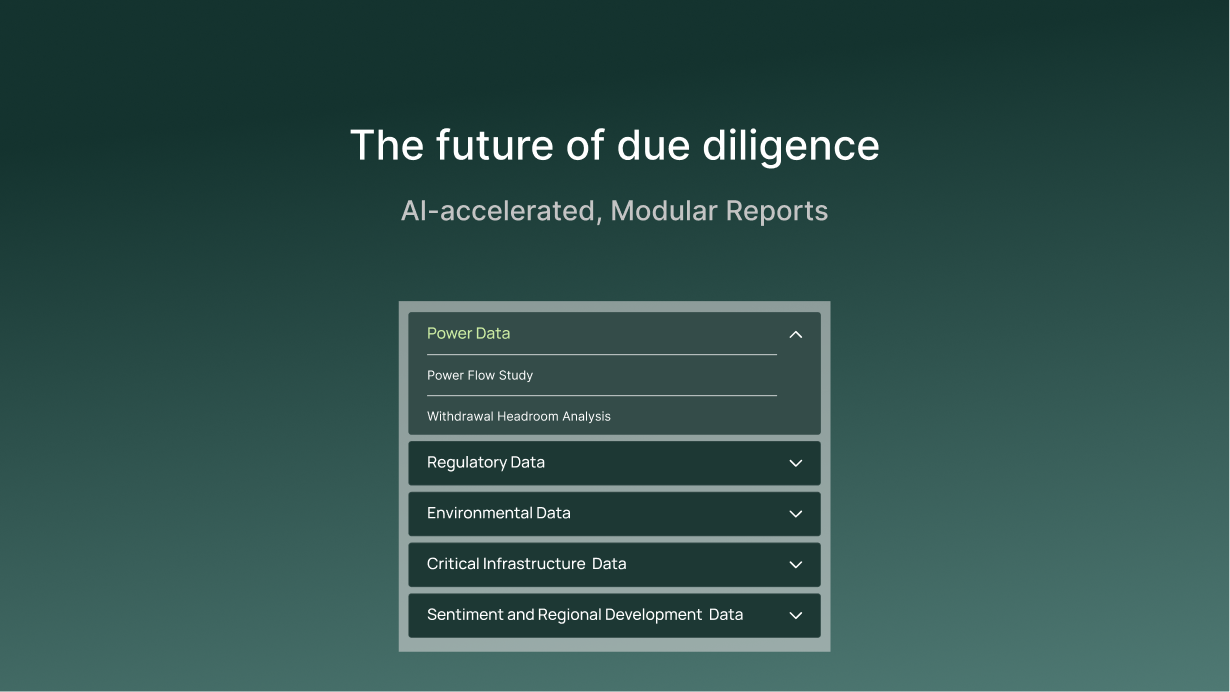
20+ data modules across five categories
Instead of ordering predefined reports, you choose from 20+ site intelligence modules across five categories:

Select the modules that matter for your decision. Whether that's early-stage screening with 3-4 critical factors, mid-stage diligence requiring engineering-grade depth on specific risks, or late-stage validation across regulatory and community dimensions.
When you need full site due diligence depth, we still deliver industry-standard reports, like our Critical Issues Analysis and Power Flow Study, faster than traditional energy consultants
Modular reports complement these comprehensive offerings. Use modular reports for validation on projects risks and wuick decision-making. Deploy comprehensive reports on sites to show investors and other third parties a comprehensive third-party audit. Layer in additional modules as projects advance.
5-day delivery vs. 12 week traditional timeline
Traditional reports: Typically 12 weeks, multiple vendors or disconnected teams, siloed delivery, months before complete site intelligence.
Paces Modular Data Reports: 5 days. All analyzed by AI, validated by expert developers and power engineers, delivered through a single platform.
Results:
- Larger site opportunity funnels
- Earlier project risk identification
- Parallel development work streams instead of sequential bottlenecks
- Evaluate more sites in the same timeframe
- Move on viable opportunities while competitors wait
- Increase operational efficiency
- Decrease capital expenditure
Custom development intelligence for energy infrastructure developers
The bottleneck in energy development isn't a lack of information; it's getting the right information at the right time for your specific workflow.
Modular data reports give renewable energy developers and data center developers the flexibility to build intelligence around their decision-making process, not force workflows around standardized reports.
You choose the modules. We deliver the intelligence. In days, not months.
Ready to see what a modular report could look like for your next solar, battery storage, or data center project?
Schedule a Demo | Learn More About Paces Reports
Sign up for emails
Find the right sites faster, assess feasibility with world class data, and track progress across your entire project pipeline with software built to compress your workflow.
.png)