The power development funnel: from siting to interconnection
The data center global market is expanding rapidly, with estimations showing that by 2030, companies will invest $2.8 trillion on data center infrastructure in the United States, according to McKinsey. With this in mind, it’s no surprise that everyone’s rushing to build. But when power is the most essential constraint and fewer optimal sites are available every month, how can developers ensure they move quickly to validate and secure power-ready sites?
The answer: validating smarter at every stage.
Traditional development treats power validation as a single gate that comes months after site control. After you've secured land, filed interconnection, and waited 12-18 months for study results. By the time thermal constraints, upgrade costs, or capacity limits surface, you've already committed capital, and your competitors may have locked up better alternatives.
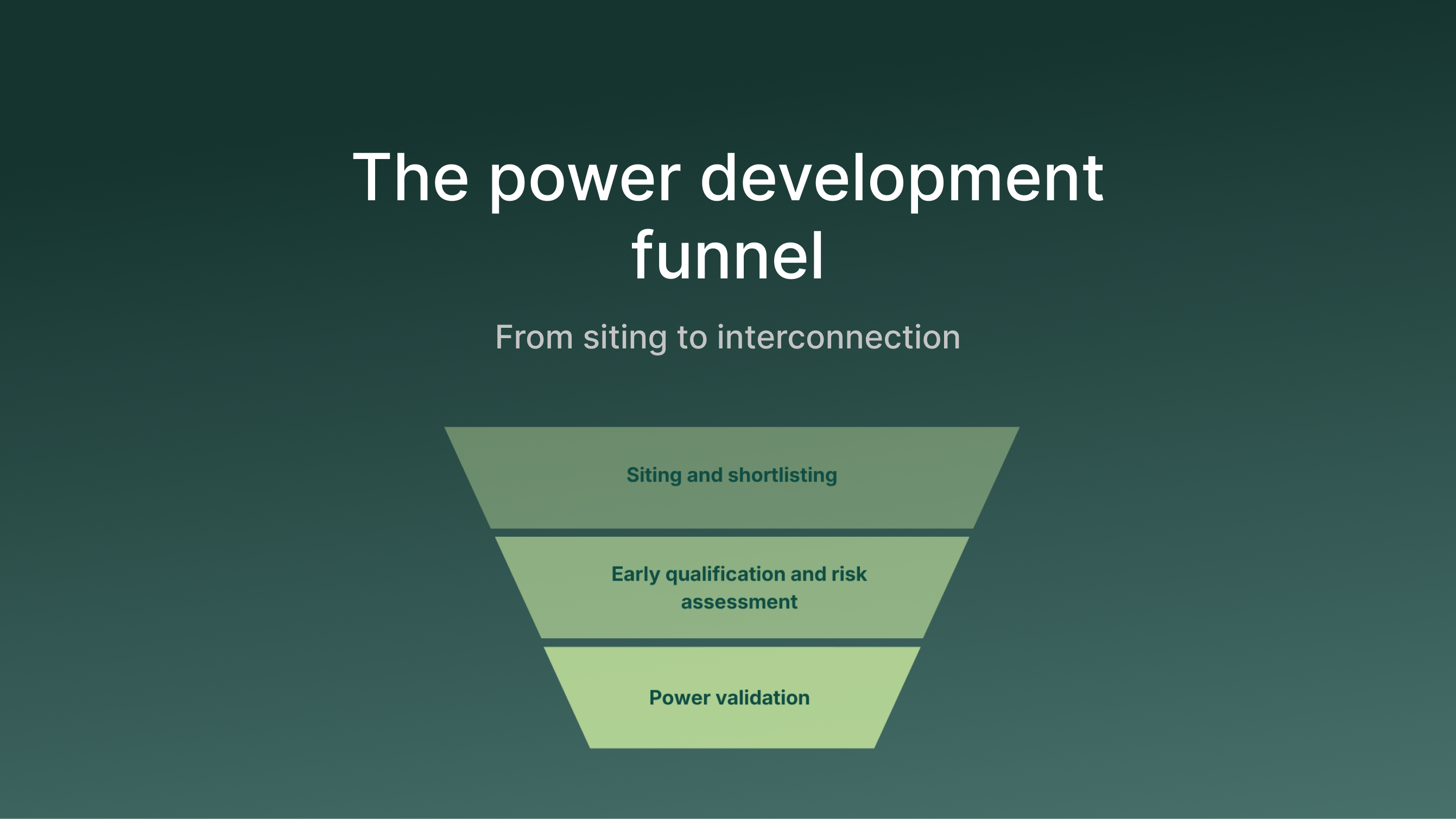
The power development funnel inverts this model. Instead of sequential validation after commitment, it enables continuous power intelligence throughout site selection while answering critical questions at each decision point before capital is deployed:
- Where is the viable land close to the grid? (Siting and shortlisting)
- What will power cost, and is capacity available? (Early qualification and risk assessment)
- What will interconnection actually require? (Power validation)
.png)
Each stage builds on the last, progressively narrowing focus from regional screening to POI-specific validation. But the competitive advantage comes from speed at every stage. What used to take months of disparate tools and consultant-led studies now happens in days or weeks, allowing developers to:
- Evaluate more sites in parallel
- Eliminate non-viable options before competitors waste time on them
- Lock up the best power-ready locations while others are still waiting for studies
In a market with $2.8 trillion chasing a shrinking pool of optimal sites, the developers who can compress speculation to certainty will win.
1. Siting and shortlisting: start with foundational grid intelligence
Power-constrained development begins with a simple question: where can you actually plug in?
Effective siting requires layered infrastructure mapping that shows transmission voltage classes, substation locations, and proximity to fiber and gas in a single view. The goal is to rapidly eliminate regions where fundamental infrastructure gaps will block progress, regardless of land quality. This foundational step prevents months of wasted effort pursuing sites that can't support the load profile your project requires.
Speed advantage: What used to require weeks of manual desktop research now happens in minutes with the right mapping tools. Screen entire states in an afternoon.
2. Early qualification and risk assessment: understand power economics and grid capacity
Once you've identified regions with the right infrastructure backbone, the next question is economics: what does power actually cost here, and is there available capacity?
Locational Marginal Prices (LMP) reveal the delivered cost of electricity at specific nodes across the grid. High LMP zones signal either constrained transmission or expensive local generation, both of which translate to higher operating costs or required infrastructure investment. Comparing LMPs across potential development areas helps prioritize where to focus limited origination resources.
But low power costs mean nothing without available capacity. This is where transmission heatmaps become essential. Heatmaps provide a visual risk-screening layer that shows the estimated available MW capacity across substations and transmission corridors. They help developers quickly identify where the grid can absorb additional load, and where it can't, before investing in site control or detailed studies.
While heatmaps don't replace formal interconnection studies, they dramatically narrow the search space, allowing teams to focus diligence on locations where both economics and physical capacity align.
Speed advantage: Screen hundreds of potential POIs in hours instead of pursuing site control on power-constrained locations and discovering capacity issues 6-12 months later. By the time traditional developers discover constraints, you've already moved to the next opportunity.
3. Power validation: de-risk before you submit
Interconnection applications require significant deposits and trigger lengthy study timelines. Submitting without confidence in feasibility is expensive.
Before filing, developers should validate their assumptions with an ISO-grade power flow study. These studies model how withdrawing power at a specific POI affects the broader transmission system under normal and contingency conditions. They identify binding constraints, estimate required upgrades, and provide a credible basis for sizing interconnection requests.
But a standard power flow study is only as good as its inputs. Two capabilities are raising the bar for what pre-interconnection validation can deliver:
N-1-1 Contingency Analysis
Standard contingency testing (N-1) evaluates what happens when a single piece of equipment fails. N-1-1 goes further, testing how the transmission system performs when a second element fails while the grid is already adjusting to the first outage. This sequential double-contingency analysis matches the rigor that utilities apply during formal interconnection review, so developers see what the utility will see before they file.
Off-cycle Case Updates
Every power flow study relies on ISO/RTO base cases that are only published once or twice a year. But the grid keeps changing in between: new upgrades get approved, loads enter the queue, and infrastructure shifts. Off-cycle case updates refresh stale base cases with the latest proposed and approved transmission changes so your study reflects today's grid, not a snapshot from months ago. This is the first automated, productized off-cycle conditioning capability available on any platform.
Speed advantage: Move from speculative site selection to validated interconnection strategy in weeks, not quarters. Submit applications with confidence while competitors are still waiting for consultant deliverables. With AI-enabled power flow studies, like Paces', you can move from question to validation in 5 days.
The accelerated path forward
The truth is, no two teams de-risk projects in the same order. Yet most power validation tools force teams into rigid workflows with heatmaps that only work at the top of the funnel, consultants who only deliver full studies after months of waiting, or internal power teams stretched too thin to keep pace with deal flow.
Winning development teams need power intelligence that scales across the entire development funnel, from early screening through final validation, delivered in days, not months, without sacrificing technical rigor. That's where the power funnel, paired with an end-to-end power development tool like Paces, can be the difference between years in development using disparate tools and workflows to weeks in development using one end-to-end tool that allows you to connect to power faster.
The result: Lock up power-ready sites 12-18 months faster than traditional approaches. Real acceleration occurs when power screening, qualification, and validation are integrated into a unified system. Where LMP data, heatmaps, and power flow studies with N-1-1 contingency analysis and off-cycle case updates connect in the same platform, giving developers a holistic view of their projects.
That's the approach Paces enables. Our map and site search allow you to layer on critical infrastructure information with LMP and heatmaps data. Power flow studies, now with N-1-1 contingency analysis and off-cycle case updates, are delivered in 5 days so you can validate against the most current grid conditions available. The developers who can compress the timeline from speculation to certainty will secure the best power-ready sites. The rest will chase what's left. If you want to see how the power development funnel works in practice, book a demo.
Sign up for emails
Find the right sites faster, assess feasibility with world class data, and track progress across your entire project pipeline with software built to compress your workflow.