Paces Introduces Transmission Line Reports and Injection Studies for Faster, More Informed Site Decisions
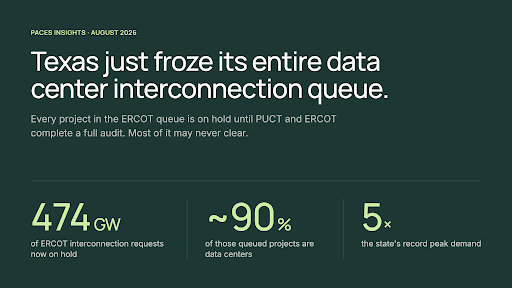
By 2028, U.S. data centers could account for 6.7% to 12% of the nation’s electricity consumption, up from 4.4% in 2023, according to the U.S. Department of Energy. Meeting that growth will require new generation and grid infrastructure to come online faster. Solar and battery storage can provide economical, scalable power, but their speed advantage only matters if the development process can keep pace. Today, that process is fragmented: site analysis, transmission planning, interconnection, permitting, and engineering each move separately, and questions that determine whether a site is viable can take months to answer. By then, grid conditions have changed, queues have moved, costs have risen, and ultimately, stronger opportunities may be lost.
Renewable projects move faster when developers know early which sites have a realistic path to the grid. That’s why we’re introducing two new capabilities during this Climate Week NYC: Transmission Line Reports and Injection Studies.
The Timeline Trap
Consider a solar developer evaluating five potential sites for a 100 MW project. The strongest locations – best solar resources, available land, and community support – may sit 30–50 miles from an existing transmission line. Before advancing any of them, the developer needs to know whether a transmission route can be built and what grid upgrades it would require, since those answers drive cost, timing, and viability.
Traditional engineering studies are comprehensive, but often take four to six months per site, In that time, utility policies evolve, interconnection queues change, nearby projects advance, and assumptions behind the business case can go stale. A developer comparing several sites can spend a year on preliminary analysis before choosing where to move forward.
Standard GIS tools can offer a faster alternative, but they lack the grid, engineering, and permitting intelligence to estimate feasibility or cost accurately. Utilities and grid planners face the same gap:comparing routes and anticipating congestion typically means lengthy, consultant-led processes.
Until now, there hasn’t been a practical middle ground: analysis fast enough to inform early decisions and detailed enough to guide capital.
Introducing Transmission Line Reports
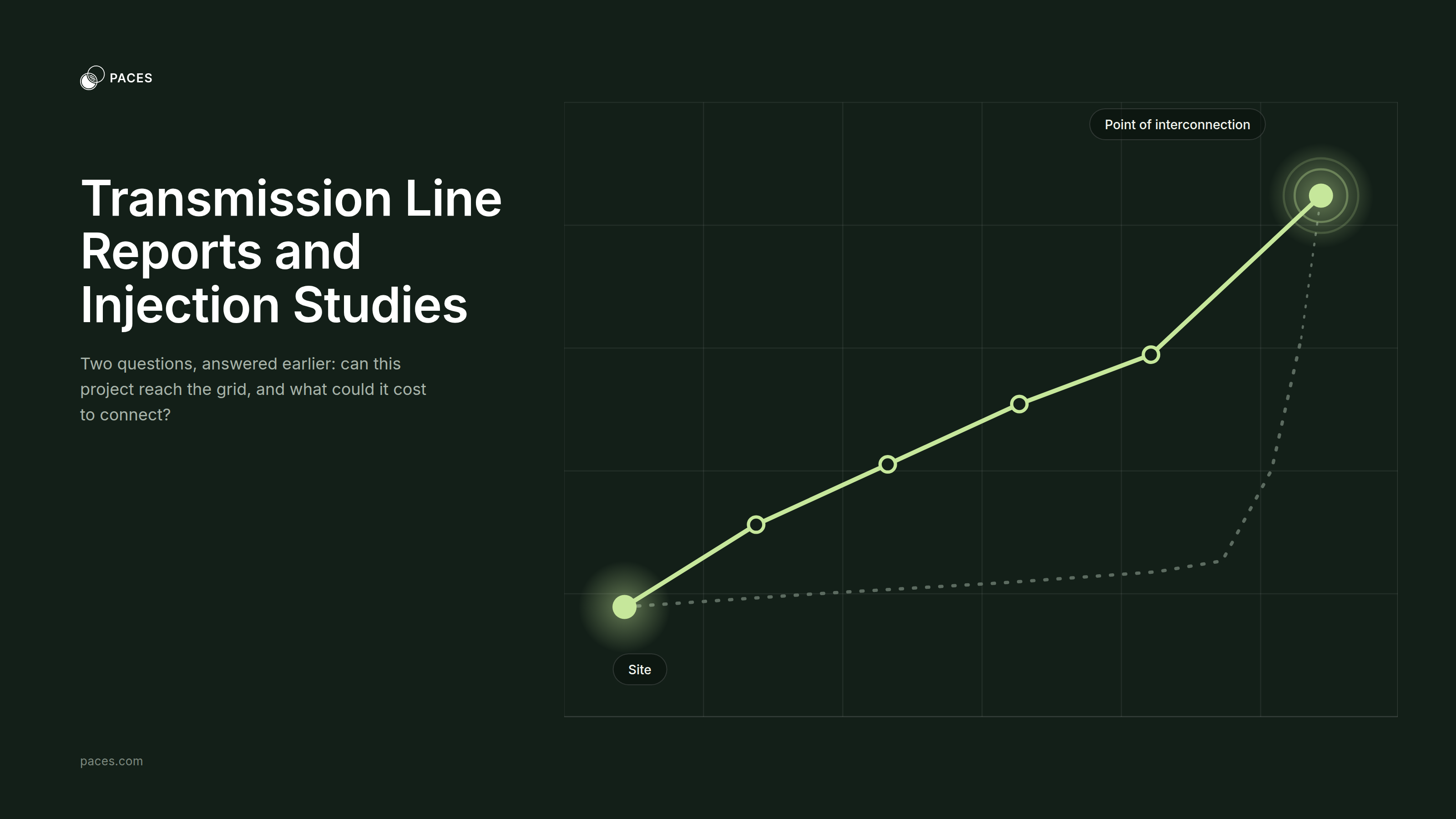
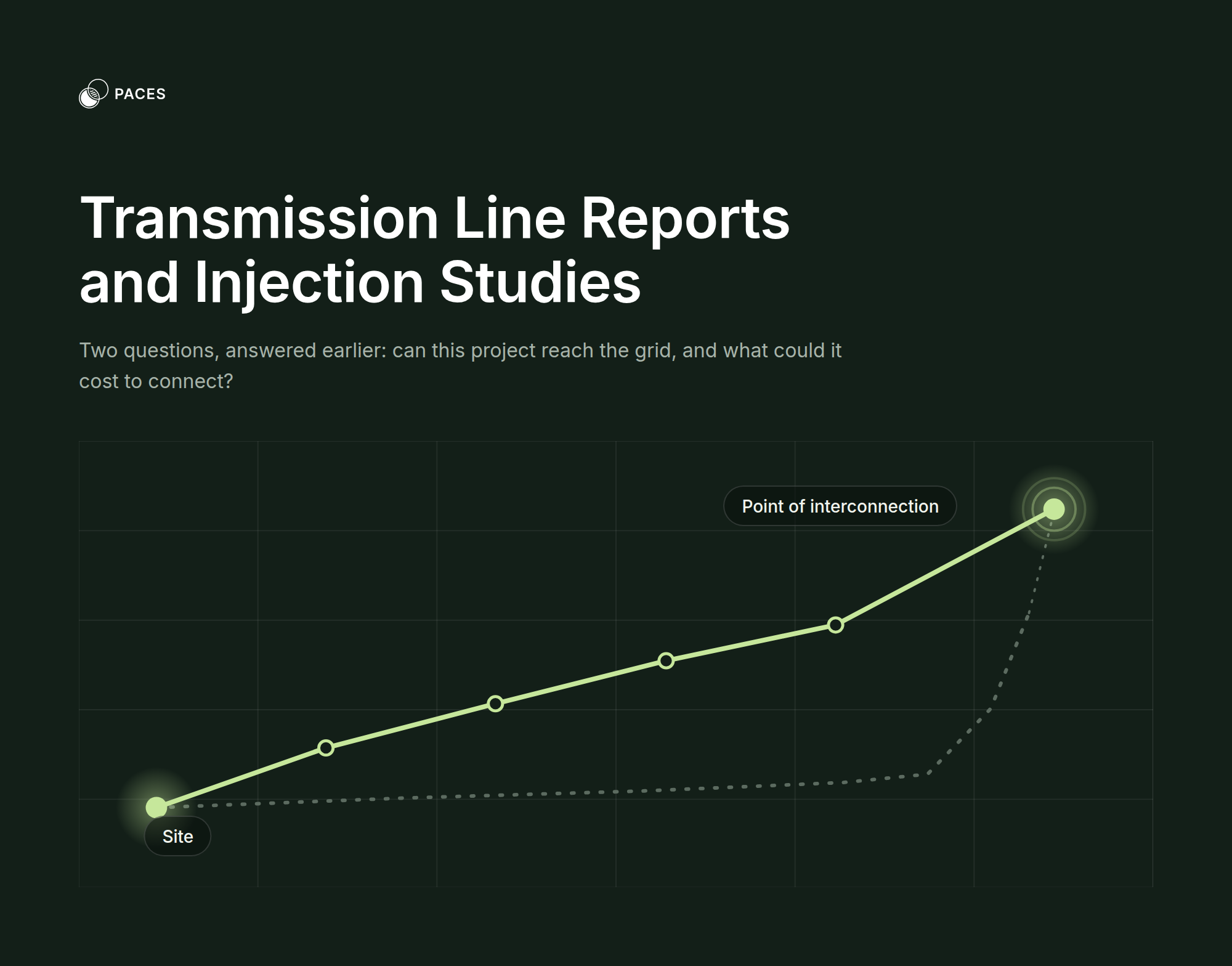
Paces Transmission Line Reports are designed to help renewable developers, utilities, and grid planners evaluate transmission feasibility in days rather than waiting months for traditional analysis.
For renewable developers
A developer evaluating a remote site needs to know whether a viable transmission route exists and what obstacles could affect it. Paces reports map potential routes, identify geographic and infrastructure constraints, and surface permitting complexity.
That visibility supports an earlier decision. If the route is viable, the team can move forward with a stronger foundation for its cost and schedule assumptions. If a route appears prohibitively expensive or difficult to permit, the developer can redirect resources before committing to a land lease or substantial engineering work.
For utilities and grid planners
A utility planning a new transmission line may need to compare several potential pathways across complex or contested territory. Paces enables teams to evaluate route options in parallel and understand the constraints and trade-offs associated with each.
Faster comparison can support more responsive grid planning when load growth, congestion, or infrastructure needs demand timely decisions.
Key benefits
- Faster feasibility analysis: Understand potential routes and constraints in days.
- Parallel route comparison: Evaluate multiple pathways without waiting for separate, sequential studies.
- Earlier site decisions: Identify transmission barriers before committing substantial capital or engineering resources.
- Stronger planning inputs: Establish a more informed basis for project schedules, budgets, and next steps.
Transmission Line Reports are now available in limited volume for early adopters.
Forecasting Interconnection Costs with Injection Studies
Transmission feasibility is only part of the equation. Renewable developers must also understand what network upgrades may be required, and what those upgrades could cost.
When a solar or battery storage project connects to the grid, utilities conduct power-flow analysis to determine whether additional infrastructure is needed. The associated study, application, and upgrade costs can materially change a project’s economics.
In one recent Paces customer case, early validation showed that a planned downstream interconnection study was unnecessary, helping the developer avoid approximately $500,000 in costs before that capital was committed.
Developers often receive this information only after entering the interconnection queue, securing land, and committing engineering resources. If the required upgrades are more expensive than expected, a project that once appeared attractive may no longer pencil out.
Consider a battery storage developer comparing three potential sites:
- Site A: Strong location fundamentals and low land costs; estimated interconnection cost of $8 million.
- Site B: Moderate land costs and solid project fundamentals; estimated interconnection cost of $1.2 million.
- Site C: Competitive land pricing and a strong location; estimated interconnection cost of $2.8 million.
Based on land and location alone, Site A might initially appear to be the strongest choice. Once expected interconnection costs are included, Site B becomes the more attractive economic opportunity.
That visibility changes the site ranking before capital is locked in.
Paces Injection Studies are designed to forecast potential interconnection costs earlier in the development process, allowing teams to compare sites using a more complete view of project economics.
Key benefits
- Earlier cost visibility: Estimate potential interconnection costs before finalizing major land or engineering commitments.
- Better site comparison: Evaluate locations using grid costs alongside land, resource, market, and permitting considerations.
- Reduced capital risk: Identify sites with uneconomic upgrade requirements before they absorb substantial development spend.
- Faster prioritization: Focus the pipeline on projects with a more credible path to interconnection.
Injection Studies are in closed beta testing and will be available to all customers in mid-Q4 2026.
Built Around Customer Decisions
Transmission Line Reports and Injection Studies grew directly from conversations with developers, utilities, and grid planners.
For more than a year, customers have asked for faster answers to the transmission and interconnection questions shaping their projects. They needed project-specific analysis delivered early enough to influence site selection and capital allocation.
That is how we approach product development at Paces: stay close to the decisions customers are making, identify the bottlenecks slowing them down, and build tools that make those decisions faster and more informed.
Where We’re Going Next
These initial capabilities are an important milestone, and we are continuing to develop both with input from early customers.
For Transmission Line Reports, future development will support more complex scenarios, including multiple potential routes, different construction timelines, and comparisons between upgrading existing infrastructure and building new lines. Our goal is to enable developers and planners to test a range of possibilities before committing to a single path.
For Injection Studies, we are working toward probabilistic cost modeling. Instead of providing only a single estimate, future reports could show a likely range, for example, projected interconnection costs between $1.8 million and $3.2 million at a defined confidence level. This will help teams make decisions with more information about expected costs and the level of uncertainty that remains.
Get Better Planning Data, Faster
AI infrastructure, data centers, advanced manufacturing, and broader electrification are adding unprecedented demand to the grid. Renewable energy can help serve that growth, but only if viable projects can move through development fast enough.
The biggest constraint right now is time: the time it takes to determine whether a project can reach the grid, what infrastructure it will require, and whether the economics make sense.
Accelerate that timeline and the whole process changes. Developers can screen more sites and advance the strongest ones sooner. Capital can move toward projects with credible economics before competitors even finish their feasibility study. Utilities can compare infrastructure scenarios fast enough to keep pace with how quickly demand is actually changing. None of this replaces engineering judgment. Instead, stakeholders have access to better information earlier when it can still inform decisions.
If your organization is developing renewable energy or grid infrastructure and would like to use these capabilities, or help inform how we build them out, please contact the Paces team.

Sign up for emails
Find the right sites faster, assess feasibility with world class data, and track progress across your entire project pipeline with software built to compress your workflow.
.png)